
Sustainability pressure is growing. For multinationals in Asia-Pacific (APAC), moving to 100% renewable energy is now key to staying aligned with investor expectations, regulations, and long-term cost strategies.
This shift extends to supply chains too. Apple, for example, aims to power its entire supply chain with 100% renewable energy by 2030. So far, over 320 suppliers — covering 95% of its manufacturing spend — have committed to the goal. Clean energy is now a shared responsibility across ecosystems, not just within companies.
But in APAC, achieving this isn’t straightforward. Each country has different infrastructure, policies, and market options. Ambition isn’t enough — companies need a clear, localised roadmap using proven tools.In this article, we explore how companies are using RECs, PPAs, VPPAs, and Green Tariffs to meet renewable energy targets across the region.
4 Strategic Levers to Reach 100% Renewable Energy
According to the 2024 RE100 Annual Disclosure Report, corporates do not rely on a single solution. Instead, they deploy blended procurement portfolios tailored to local energy markets and aligned with global reporting standards.
1. Onsite Generation
Onsite generation refers to renewable systems, typically rooftop or ground-mounted solar, installed directly at corporate facilities. The electricity generated is consumed on-site, reducing grid reliance and providing one of the most credible and visible pathways for Scope 2 decarbonisation.
| Subtype | Description |
| Onsite Installation (CapEx) | The customer owns and finances the solar system and consumes all generated electricity. The renewable energy certificates (RECs) are bundled, meaning the customer owns both the electricity and the associated attributes. |
| Onsite Solar Power Purchase Agreement (Zero CapEx) | The developer installs, owns, and maintains the system while the customer purchases the solar output at an agreed tariff. The RECs are bundled and transferred or retired on behalf of the customer. |
Corporates favour onsite generation because it delivers direct Scope 2 emissions reduction, long-term cost savings, greater energy resilience, and clear sustainability visibility. Financing is flexible, allowing companies to choose between capital expenditure or zero-capex PPA models.
2. Offsite Generation
Offsite generation are long-term contracts in which corporates purchase renewable energy from remote projects through the national grid. They have become a cornerstone of additionality by providing developers with financial certainty to enable construction of a new clean energy project that would not have existed otherwise.
| Subtype | Description |
| Offsite Power Purchase Agreements (PPA) | Electricity is delivered through the grid from a specific renewable project. The RECs are bundled within the contract, giving the buyer both the electricity and the environmental attributes. |
| Virtual Power Purchase Agreements (VPPA) | A VPPA is a financial contract for difference (CFD) with no physical delivery. The corporate settles market price differences but still receives RECs from the project. These RECs are unbundled and count toward renewable energy goals when transferred and retired properly. |
Corporates adopt offsite PPAs and VPPAs to gain price stability, lock in renewable supply, demonstrate additionality, and build diversified procurement portfolios across markets.
Regional momentum is growing. In Singapore, Microsoft signed a 20-year VPPA with EDPR’s SolarNova 8 project, covering 1,075 government buildings and marking the nation’s largest solar project. This agreement supports both Microsoft’s goal of achieving 100% renewable energy for its electricity consumption and Singapore’s national solar targets.
Vietnam’s 2024 Direct Power Purchase Agreement (DPPA) decree now enables corporates to buy electricity directly from renewable generators through the wholesale market. In Malaysia, the Corporate Renewable Energy Supply Scheme (CRESS) launched in 2024 allows corporates to contract renewable electricity through the national grid.
These frameworks represent a structural shift away from reliance on standalone RECs toward scalable, grid-based clean energy sourcing.
Related: Malaysia Cuts CRESS & CREAM Grid Fees by Up to 40% to Boost Corporate RE Adoption
3. Renewable Energy Certificates (RECs)
Renewable Energy Certificates verify that one megawatt-hour of renewable electricity has been generated and added to the grid. They remain the most flexible instrument for corporates to claim renewable consumption across dispersed or leased operations.
RECs are recognised by RE100, CDP and SBTi for market-based Scope 2 accounting, enabling companies to move quickly at scale while longer-term onsite or PPA solutions are planned.
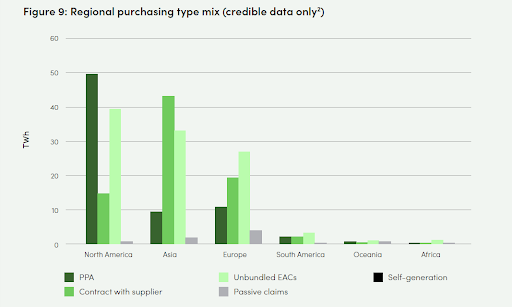
Source: RE100 Annual Disclosure Report 2024 (Figure 9, p. 25).
In 2024, RE100 members reported about 33 TWh of renewable procurement through unbundled RECs, making it the second-largest procurement mechanism in Asia after contracts with suppliers at ~43 TWh.
Given these dynamics, corporates are increasingly prioritising high-integrity certificates notably I-REC and TIGR. Along with careful attention to project location, registry credibility and vintage, to safeguard brand reputation and ensure credible Scope 2 reporting.
Related: The Importance of REC: Understanding Its Significance
4. Green Tariffs
Green tariffs allow corporates to purchase renewable electricity directly from utilities or licensed suppliers, typically bundled with RECs. They provide a straightforward way to green grid electricity in regulated markets without requiring new infrastructure or complex bilateral contracts.
Corporates choose green tariffs for their simplicity, regulatory recognition, and accessibility to smaller or leased sites. They often serve as an entry point before transitioning to PPAs or unbundled RECs.
In Malaysia, the Green Electricity Tariff (GET) enables subscribers to procure verified renewable blocks backed by mRECs. In the Philippines, the Green Energy Option Programme (GEOP) opens access to renewable supply through accredited providers.
Thailand’s Utility Green Tariff (UGT), regulated by the ERC and implemented by EGAT, MEA, and PEA, allows corporates to purchase renewable electricity bundled with I-RECs, offering transparent, RE100-aligned claims.
Meanwhile, Indonesia’s PLN has launched the Green Energy as a Service (GEAS) initiative, delivering renewable-based electricity with certified I-RECs—a utility-led solution supporting the country’s industrial decarbonisation.
While these programmes mark important progress in Asia’s energy transition, most corporates ultimately complement them with high-integrity RECs or long-term PPAs to strengthen climate-claim credibility.
Related: Malaysia’s Green Electricity Tariff (GET) Has Restructured — Now on a Fixed-Pricing System
A Winning Strategy: The Blended Procurement Portfolio
There is no single pathway to 100 percent renewable electricity in Asia Pacific. Leading RE100 members are adopting blended strategies that combine multiple mechanisms. This integrated approach ensures credible Scope 2 reporting, stronger energy resilience, and greater investor confidence while balancing ambition with practical market realities.
Start Your Journey to 100% Renewable Energy Today
At Saxon Renewables, we partner with leading corporates across APAC to design and execute renewable energy procurement strategies that are both credible and scalable.
Whether through Onsite, Offsite, RECs, or navigating Green Tariffs, our expertise ensures your journey to 100% renewable electricity is aligned with global standards and tailored to the local market.
If your organisation is ready to turn ambition into action, our team is here to guide the way.