
Malaysia’s Green Electricity Tariff (GET) has recently been updated, reshaping how businesses access and pay for renewable energy. Since 2021, green electricity programs have delivered over 10,500 GWh of clean energy to more than 3,500 users, helping them meet sustainability targets. Tenaga Nasional Berhad (TNB) has introduced a revamped Green Electricity Tariff (GET) program called GET Greenpath, effective July 1, 2025. It offers a fixed-rate pricing structure and includes official Malaysia Renewable Energy Certificates (mRECs) for participating businesses.
Here’s what business leaders like you need to know to align with this update.
What’s New in GET Greenpath?
Simplified Rate Structure
Effective July 1, 2025, the revised Green Electricity Tariff (GET), now known as GET Greenpath, introduces a single-tier premium rate to replace the previous category-based structure.
Businesses can now choose from:
- 5 sen/kWh for a 1-year subscription
- 4 sen/kWh for a 2-year subscription
- 3 sen/kWh for a 3-year subscription
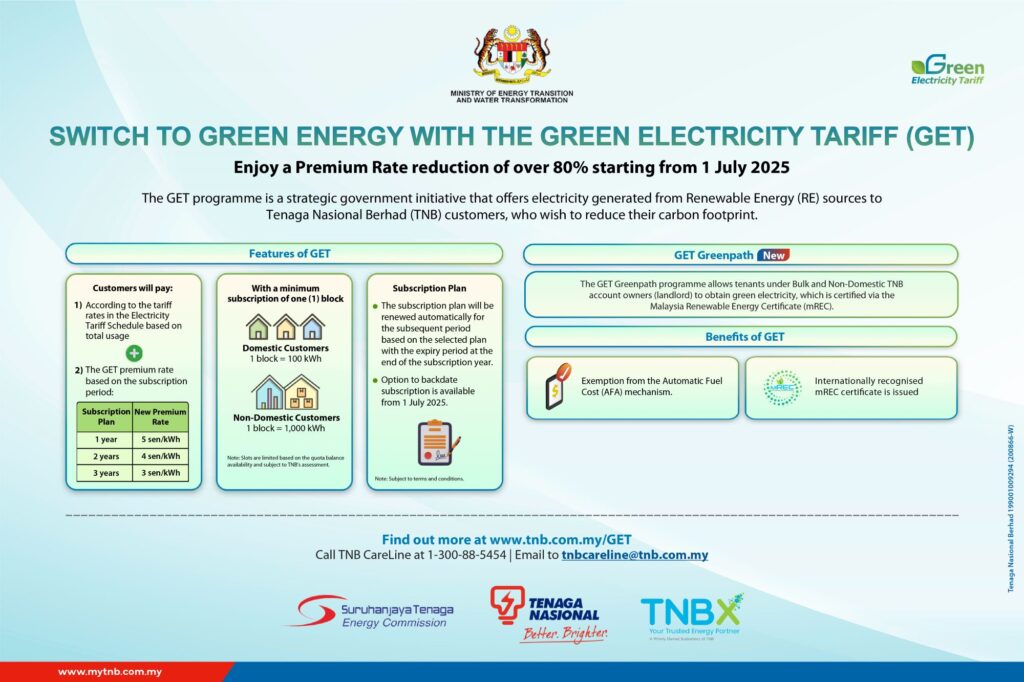
Malaysia slashes its Green Electricity Tariff (GET) surcharge by 80% and introduces the GET Greenpath program (Source: TNB)
Lower Rates Compared to Previous GET Premiums
The new Greenpath rates are significantly lower than the previous GET premiums:
- 10 sen/kWh (for domestic and low-voltage non-domestic users)
- 20 sen/kWh (for medium/high-voltage users)
The older rates helped offset the Imbalance Cost Pass-Through (ICPT), which was recently discontinued following TNB’s tariff restructuring and replaced by the new Automatic Fuel Adjustment (AFA) mechanism.
Historically, ICPT charges fluctuated semi-annually, with recent costs reaching RM0.16 to RM0.17 per kWh, making the GET cost roughly 3 to 4 sen/kWh after offsetting.
The streamlined structure makes budgeting easier and supports wider adoption of renewable energy.
As with the previous GET, subscribers continue paying their standard electricity tariff plus the selected green premium — and in return, they receive mRECs that certify their use of clean energy.
The Old GET Vs. GET Greenpath
| Feature | Old GET | GET Greenpath |
|---|---|---|
| Premium Rate | Low Voltage 10 sen/kWh (1 year) 9 sen/kWh (2 years) 8 sen/kWh (3 years)Medium/High Voltage 20 sen/kWh (1 year) 19 sen/kWh (2 years) 18 sen/kWh (3 years) | 5 sen/kWh (1 year) 4 sen/kWh (2 years) 3 sen/kWh (3 years)0.2 sen/kWh (administrative and operational charge) |
| Fuel Charge Exemption | ICPT – Change every 6 months3.7 sen/kWh (Low Voltage) 16 sen/kWh (Medium/High Voltage) | AFA – Change every monthCurrent 0 sen/kWh, cap at +- 3 sen/kWh |
| Rate Type | Category-based | Single-tier |
| Comes with mRECs | Yes | Yes |
| Flexibility | 1,2, or 3-year terms | 1, 2, or 3-year terms |
| Tenant Access | No | Yes, under tenant accounts |
What is “Tenant Access”?
Under the GET Greenpath program, non-domestic tenants without direct TNB accounts (e.g. tenants in commercial buildings) can now access green electricity through the registered account holder.
A key enhancement from the previous GET scheme is that mRECs will be issued directly in the tenant’s name.
As long as the landlord or building manager properly registers and declares the tenant account, the tenant can receive full credit for their green electricity usage.
This enables tenants to directly claim the environmental attributes of their energy consumption and enhance their sustainability reporting.
Understanding mRECs
Both GET and the revised GET Greenpath provide mRECs verified under the internationally recognized, I-REC Standard.
These certificates confirm the renewable origin of electricity and support credible Scope 2 emissions reporting under global frameworks like the GHG Protocol and CDP.
However, subscribers can’t choose the energy source (mRECs are issued from large-scale solar and/or hydropower as approved by the Energy Commission).
Further Reading: Renewable Energy Certificates (RECs): A Global Overview and Key Players in Asia
Photo by Unsplash
So What Should My Business Do Next?
Step 1: Review Your Current Subscription Status
If your business is currently subscribed to the old GET scheme, begin by reviewing your subscription details, including existing premium rates and whether you benefit from ICPT exemptions.
Step 2: Decide Whether to Stay or Terminate
For existing GET users, no action is required to transition to the new Greenpath rates. The updated premium structure will be applied automatically starting July 1, 2025.
However, if you’re concerned about the removal of ICPT/AFA exemptions or seeking more cost-effective options, termination can be done without penalty via the myTNB portal before 31 August 2025.
Step 3: Explore Alternatives for Renewable Energy Certificates (RECs)
While GET Greenpath provides a simplified route to accessing RECs, it may not offer the flexibility or lowest cost for every business.
How Saxon Renewables Can Help
Saxon Renewables offers a tailored approach to REC procurement:
- Rates lower than 3 sen/kWh
- Certified RECs under global standards like TIGR and I-REC
- Custom volumes and delivery without fixed subscription blocks
- Support credible with international Scope 2 reporting frameworks
We can help you build a smarter, flexible, and cost-effective Renewable Energy Certificates procurement strategy – contact us today!
Final Thoughts
Previously, GET operated on a category-based premium of up to 20 sen/kWh, but came with ICPT exemptions that reduced the total cost of green electricity — especially for medium to high-voltage users, who could offset RM0.16–0.17/kWh.
Now, GET Greenpath introduces a simplified single-tier premium rate of 3–5 sen/kWh depending on subscription duration, but no longer includes the ICPT exemption.
As a result, while the green premium appears lower, the net cost may not necessarily be cheaper depending on the user’s voltage category and previous ICPT savings.
Note: mREC is a branding for all RECs redeemed by TNBX for consumers in Malaysia. The mREC logo is trademarked by TNBX and is issued under the internationally recognized I-REC Standard.
Looking for a decarbonization and sustainability partner?
Saxon Renewables supports companies at every stage of their sustainability journey, from early-stage planning to implementation and long-term optimisation. We’ve worked with RE100 signatories, CDP participants, and Fortune 500 companies, ensuring they deliver real climate impact responsibly, profitably, and confidently.